Some of you may have read my previous blog post about comparing the performance of five 50mm enlarging lenses. I'm proud of the work I put into that post, but I wanted to develop a more standardized way of testing enlarging lenses without necessarily having multiple lenses of the same focal length.
In comes Vlad's Test Target (link to his website), a fine-grain mounted negative designed to calibrate camera-scanning rigs. I stumbled upon his product online, and immediately saw how useful it could be in the darkroom to test lens resolution and center-to-corner performance. The test slide is made with Adox CMS Pro II film and has an official resolution of 110 line pairs per millimeter (lp/mm). Details this fine rival the resolution achievable on fine-grain films such as Kodak TMax1001 and Ilford Delta 100. Adox CMS Pro II is incredibly fine-grained and is capable of resolving up to 800 lines per millimeter (l/mm), so the limitation of the film stock itself will have no effect on this experiment. The design and principle behind the test pattern can be found here. As of now I only have the 35mm version of this slide, which I don't plan to use to test lenses longer than 80mm (Vlad makes test targets in larger sizes).
Vlad graciously provided me with this high-quality scan from his test slide, which shows the test lines alongside their corresponding resolution in lp/mm. Note how small this area is on the slide itself (1.5 x 1.3mm); it can be viewed in some of my test prints below. The slide was scanned by Dominique Ventzke at High End Scans.

To prevent this post from getting too lengthy, I focused on testing only two lenses that in my opinion are on opposite ends of the quality spectrum: the EL-Nikkor 50mm f/2.8 and the EL-Omegar 50mm f/3.5. My hope in testing these particular lenses was that I would see similar results in center sharpness but noticeably different results in the corners. The EL-Nikkor was tested at print sizes of 5x7, 8x10, and 16x20. The EL-Omegar was only tested at 16x20, to most clearly illustrate the difference between the two lenses. I did not print full sheets at each of these sizes (only for the 5x7), but rather adjusted the enlarger to the proper size, and printed a small area of the test slide that contained the area I wanted to analyze. I made all prints at f/8, both to simplify the procedure and to give the lenses their shot at the most "ideal" printing aperture.
Each of the resulting prints was scanned at 1200dpi on a flatbed scanner. At this resolution, the test target and the lenses being used are the limiting factor rather than the resolving capability of the scanner.
 |
| 5x7 print of the test slide using EL-Nikkor 50mm at f/8. |
The 5x7 print was, as expected, very sharp and the details were all excellently resolved. I wasn't expecting to push any limits at this size, just needed a straight print. The corner details appear to be exactly as sharp as the details in the center. When I zoom into the scanned print, I can see slight differences in sharpness, but the difference is indiscernible to the naked eye.


At 16x20, my enlarger has reached its maximum height without having to adjust it to project onto the floor. The very smallest details are visible now, and the resolution limit of the test target has been reached. The corners are quite obviously softer than the center, but still very suitable for printing.


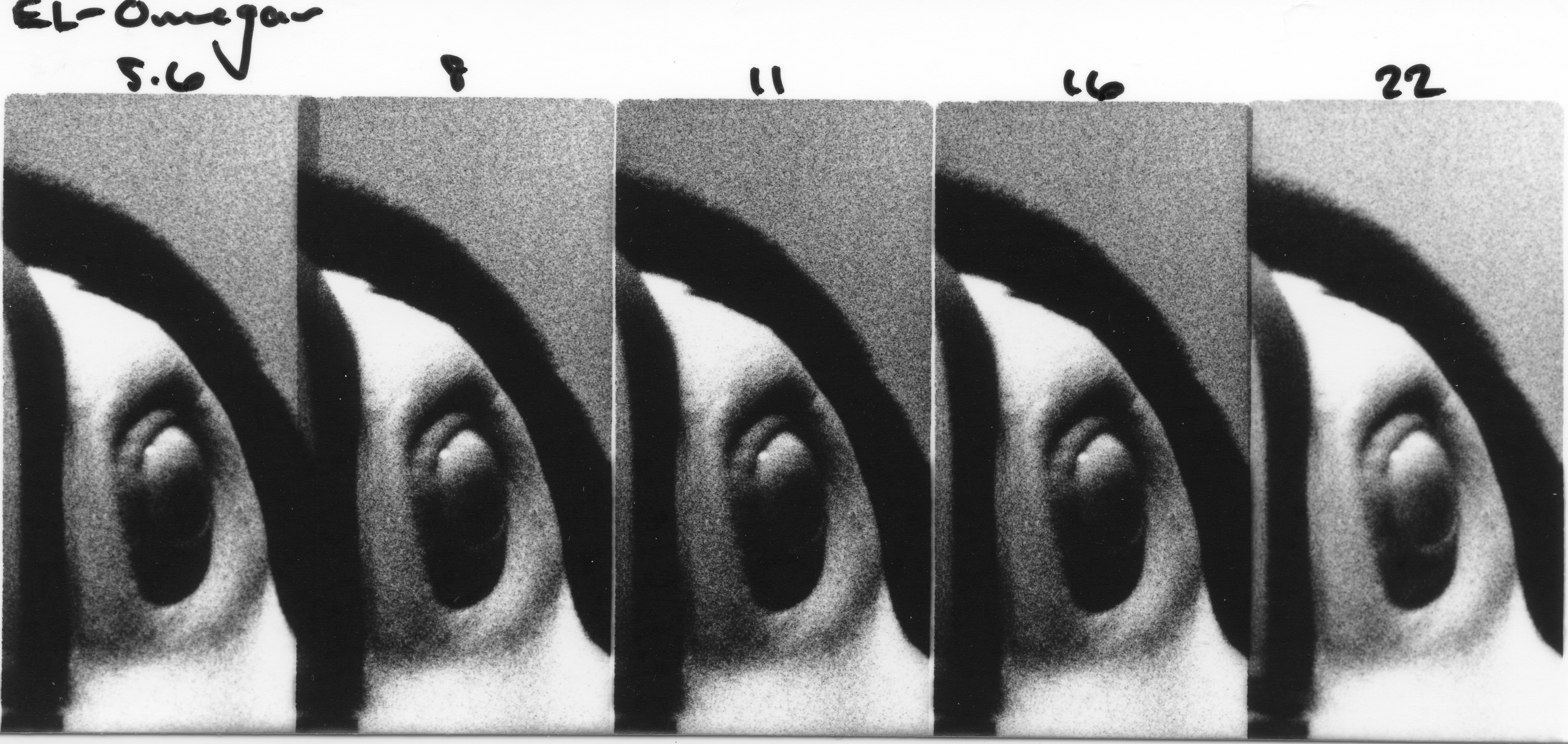
And here are the results from the EL-Omegar. In my last discussion on this lens, it mainly showed inconsistencies between aperture settings and overall poor sharpness at all but the most ideal apertures. These prints reveal another interesting characteristic of this lens, particularly in the corners. The center is arguably as sharp as that of the EL-Nikkor, especially at f/8, which is expected to be the sharpest. What was interesting was the distortion that can be seen in the corners. The test lines that are tangential to the lens appear decent, but significant blurring can be seen in the radial lines.
 |
| Cropped in from the previous photo; the difference between radial and tangential lines is very obvious. |
I'm no optical engineer, but I can only assume the effect we see here is a factor of lens design, and not of anything about my setup. I would always expect a lens to lose some sharpness in the corners, but this is almost beyond usable. The distortion blurs details in the 15-17 lp/mm range, which would considerably reduce resolution when printing even the grainiest films.
In conclusion, I'm very satisfied with the results I was able to obtain with Vlad's Test Target. It is a quality product, perfectly suited for darkroom use, and highly recommended by me. I believe the results I obtained are very clear and the differences between these two lenses thoroughly demonstrated. I always welcome feedback of any kind, and hope that this post is of some use to those reading it!
Thank you.
1. The official datasheet for TMax100 lists a resolution of 200 lines/mm. Converting to line pairs per mm gives 100 lp/mm, barely less than the resolution limit of the test target.